As a contract manufacturer for surgical instruments, Erchinger combines modern machinery, high in-house manufacturing depth and decades of experience — for reproducible precision from raw part to assembly-ready component, made in Tuttlingen.
The manufacturing of surgical instruments covers the machining and additive production of components in surgical steel and titanium to the highest dimensional accuracy and reproducibility. As a contract manufacturer and OEM partner based in Tuttlingen — one of the world's leading centres of medical technology — Erchinger carries out nearly every manufacturing step in-house: from raw part through machining, surface finishing and cleaning to an assembly-ready component.
"Our modern infrastructure and years of expertise allow us to implement your requirements with the utmost precision and reproducibility."
High in-house manufacturing depth, modern machinery and validated processes — Erchinger covers nearly every production step of surgical instruments in-house.
From machining to surface finishing — our technical services in detail.
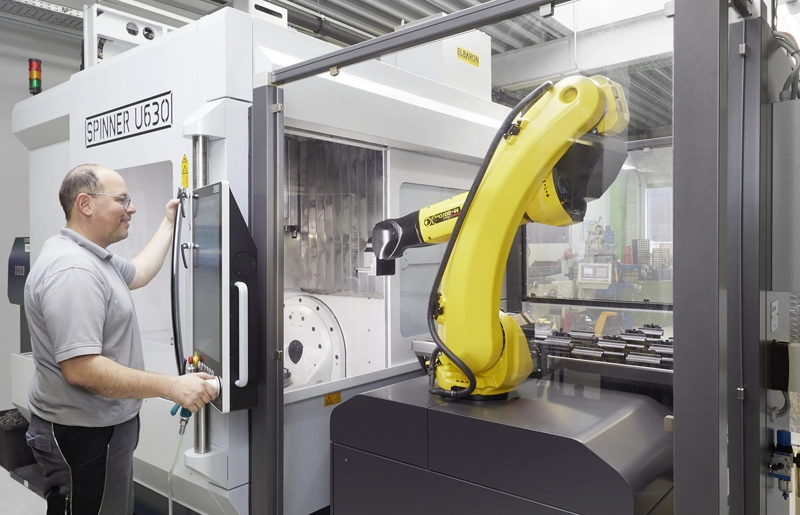
Modern milling centres, some with automated robotic loading, for complex geometries with tight tolerances.
Simultaneous 5-axis machining allows complex freeform surfaces and undercuts in a single setup — reducing setup errors and noticeably shortening throughput times.
Multi-axis turning for rotationally symmetric workpieces — from small batches to large series.
From delicate cannulas to solid handle parts: our automatic lathes manufacture rotationally symmetric components with tight tolerances, reproducible even in large quantities.
TIG welding, semi-automated laser welding and bonding techniques for complex assemblies.
Laser welding enables fine, low-distortion seams on thin-walled components — essential for the function of moving surgical mechanisms.
Additive manufacturing with selective laser melting for quickly available, functional prototypes.
Selective laser melting produces robust metal prototypes within a few days — ideal for testing new geometries in your hand before series release.
Grinding, brushing, satin finishing and high-gloss polishing, as well as UDI-code-compatible laser marking.
High-gloss polishing reduces adhesion in theatre, while UDI-compliant laser marking permanently and tamper-proof identifies every instrument.
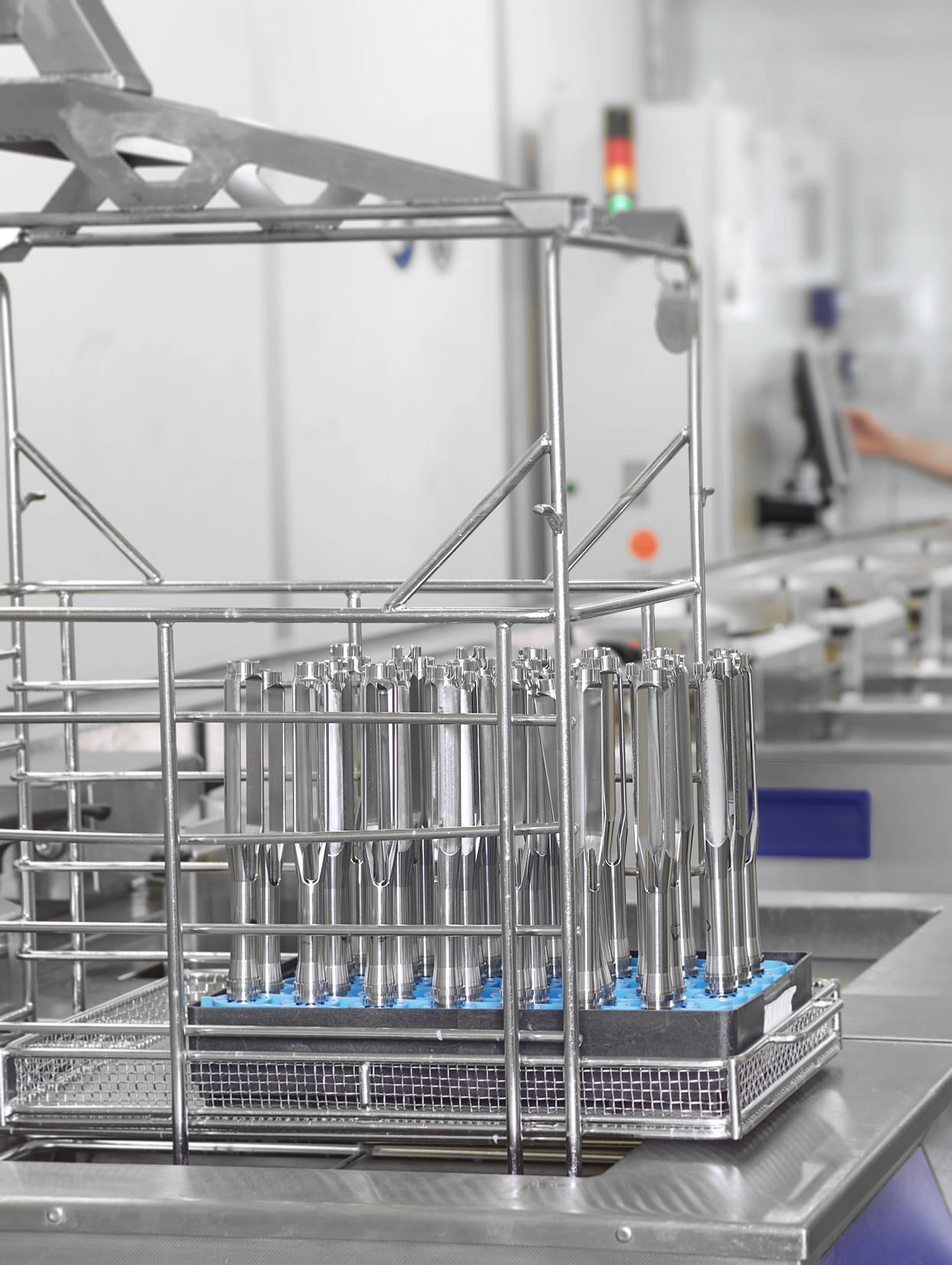
Automated ultrasonic cleaning and passivation system, along with a well-equipped inspection and measurement room.
Every component goes through validated ultrasonic cleaning and is checked for dimensional accuracy using 3D coordinate measuring technology in the measurement room before release.
Five steps from design release to an assembly-ready component.
We take the released CAD design from development and create the CNC manufacturing programmes from it. Every drawing is checked for manufacturability beforehand. This means machining and programming start without delay.
Milling, turning and other machining processes shape the precise component from the raw material. Our machinery works to tight tolerances and high repeatability. Every machining step is documented and traceable.
Depending on the application, grinding, polishing, brushing or coating of the component follows. Laser marking makes every instrument uniquely identifiable, including UDI-code compatibility. The finishing meets both functional and hygiene requirements.
In the automated ultrasonic cleaning and passivation process, every component is brought to the highest level of cleanliness. Our inspection and measurement room checks dimensional accuracy and function. Only released components proceed to the next step.
The inspected, released components go directly to our surgical instrument makers in assembly. Short distances in-house avoid loss of continuity and waiting times. This keeps the entire manufacturing process fully traceable throughout.
In-depth information about our manufacturing environment — click to expand.
3 modern 5-axis milling machines (some automated), 1 high-precision 4-axis milling machine, 4 long-bed automatic lathes for complex rotationally symmetric workpieces, and 2 short-bed automatic lathes for precise small and series parts. Complemented by surface grinding machines, a rotary swaging machine and a 200-tonne press for deep-drawing processes.
The portfolio includes TIG welding, semi-automated laser welding and bonding techniques for complex assemblies, complemented by glass bead blasting and laser marking systems that are UDI-code compatible. Surface finishing options include grinding, brushing, satin finishing and high-gloss polishing, followed by validated final cleaning.
For highly specialised process steps, Erchinger works with qualified external partners: deep-hole drilling, EDM, vibratory grinding, profile grinding, heat treatment, electropolishing, 3D printing (metal and plastic), and various coatings such as TiAlN, AlCrN, anodising or gold plating.
All manufacturing processes are validated to EN ISO 13485:2016 and are regularly revalidated. Erchinger is registered as a Contract Manufacturer with the FDA (#9611827). Every manufacturing step is documented, checked and fully evidenced through the Device History Record (DHR).
5-axis milling centres, long-bed and short-bed automatic lathes, rotary swaging machines and additive manufacturing via SLM — our machinery in Tuttlingen is designed so that nearly every manufacturing step of a surgical instrument can be carried out in-house. This breadth of technology under one roof is what makes fast response times and consistently high precision possible — from a single unit to large series.
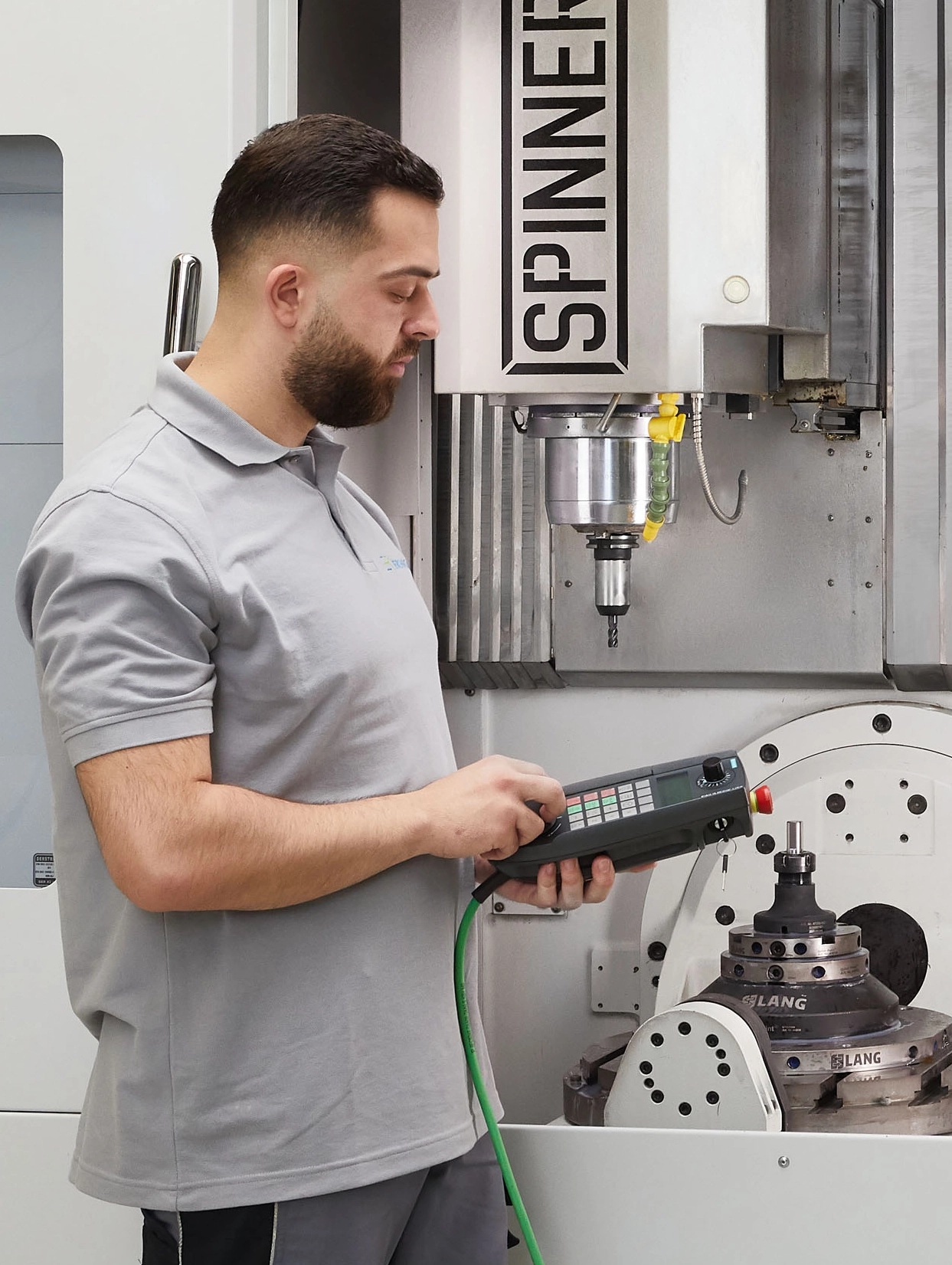
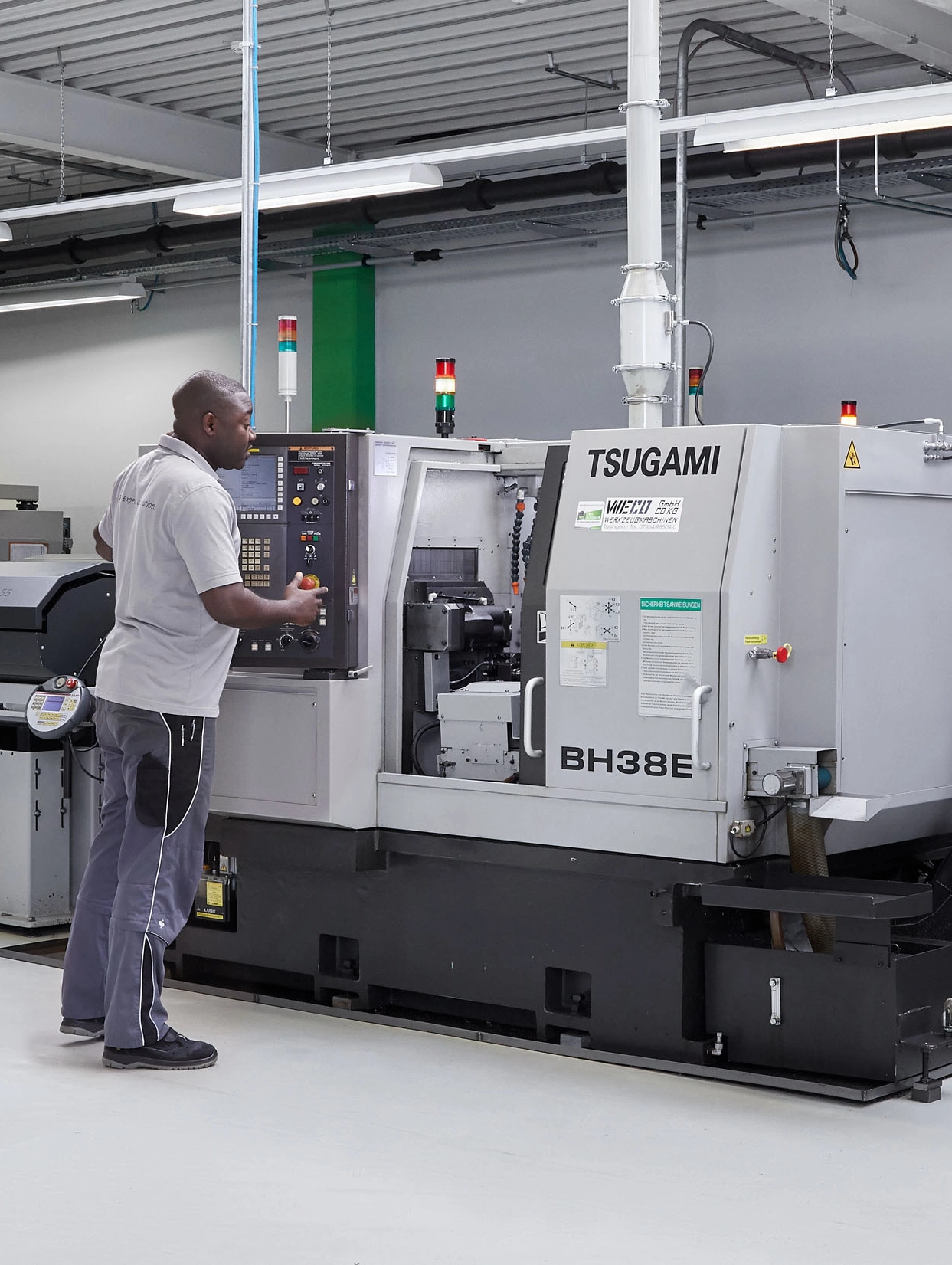
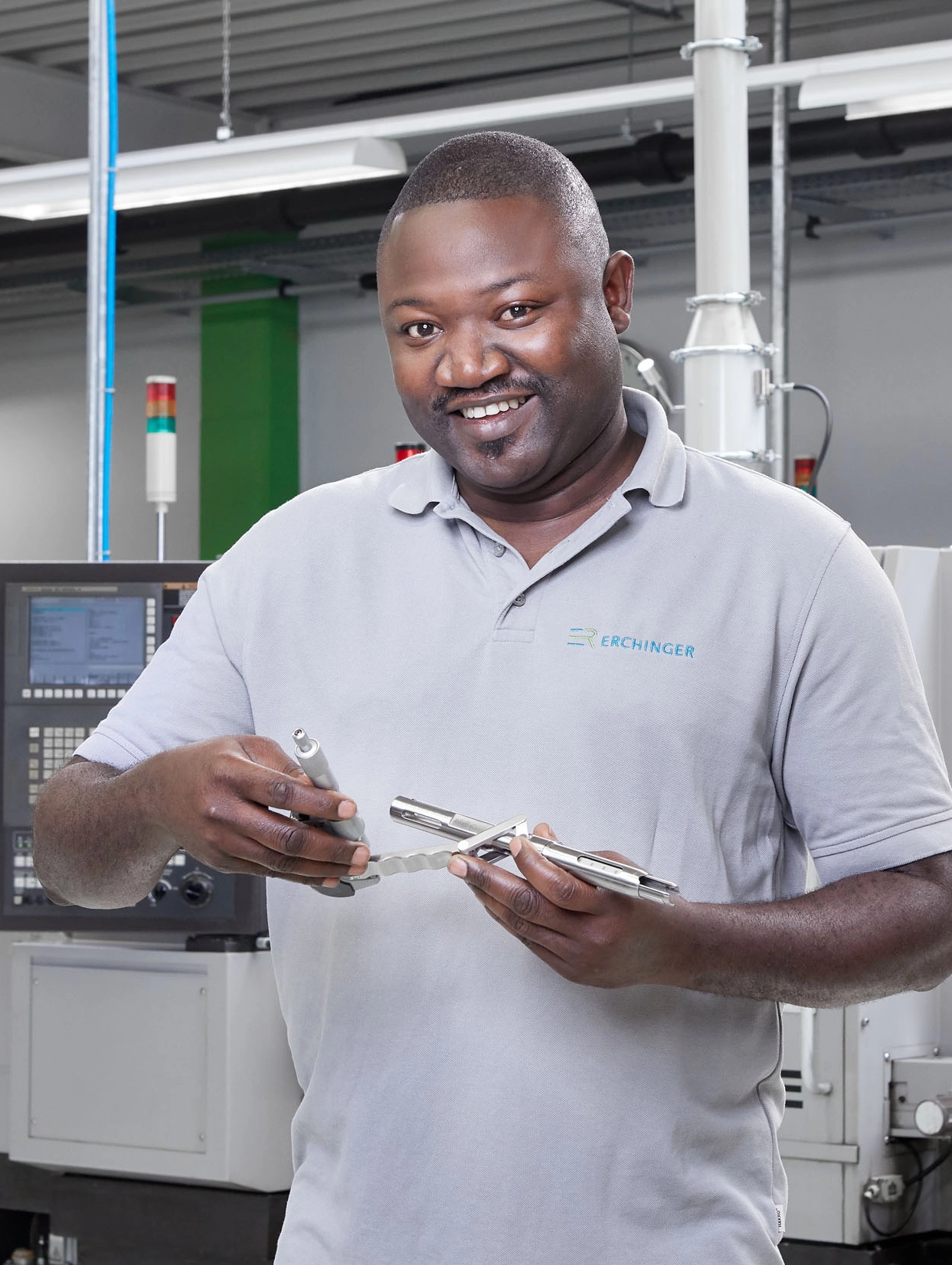
Erchinger manufactures using 5-axis and 4-axis milling machines, long-bed and short-bed automatic lathes, surface grinding machines, rotary swaging machines, and processes such as TIG welding, laser welding and laser marking. The portfolio is complemented by additive manufacturing (SLM) for rapid prototyping.
Erchinger carries out nearly every step of surgical instrument production in-house — from raw part to assembly-ready end product, including cleaning, surface finishing and laser marking. A small number of specialist processes, such as deep-hole drilling or heat treatment, are covered through qualified external partners.
Precision engineering using CNC milling and turning enables components with complex geometries and tight tolerances, as is typical and required for surgical instruments. The specific tolerance requirement is agreed with the customer on a project-specific basis.
Yes. Thanks to additive manufacturing with selective laser melting (SLM) and a high level of in-house manufacturing depth, Erchinger delivers single-unit and prototype production as well as medium and large series — flexibly scalable depending on the project phase.
Erchinger processes the materials typically used in surgical instrument making, particularly stainless surgical steels and titanium alloys, finished through processes including grinding, brushing, high-gloss polishing, and coatings such as TiAlN, AlCrN or anodising.
Contract manufacturing (also OEM manufacturing) refers to the production of goods to a customer's specifications, without the manufacturer itself acting as the brand owner. Erchinger takes on manufacturing, quality assurance and documentation, while the product is delivered under the customer's brand.
Whether a small batch, prototype or large series — we assess feasibility and deliver precise, validated, reproducibly manufactured surgical instruments.